


Healthy Ageing Hub
Your guide to health, active living and holistic well-being for life after 50.
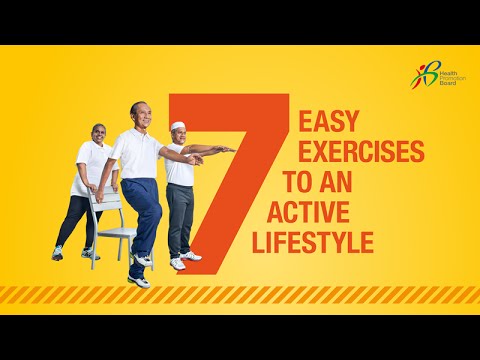
7 Easy Exercises for Active Ageing
English
华语
Bahasa Melayu
தமிழ்
When you’re 50 or older, do a mix of physical activity, including strength, balance, and flexibility exercises at least 3 days a week to improve your overall well-being, maintain physical fitness, and prevent falls.
Try these 7 easy exercises for older adults to stay active anytime, anywhere — no gym required. These exercises are great for strength training at home and can be an alternative to a gym for older adults in Singapore.
1During moderate-intensity exercise, you should be able to talk in phrases or short sentences, but not sing — a simple way to measure your exercise intensity.
Thought Spark
Think of one way you can add an exercise into your daily routine. How about some Sit to Stands home workout while watching your favourite TV show?
Health Benefits
These exercises offer the following important health benefits for older adults:
Increase or maintain muscle strength
Improve balance, coordination, and mobility
Stay confident and support independent living
Lower risk of falls
Enhance mood and overall well-being
Stay Safe while Exercising
Your safety is our priority. Before you start, please keep these points in mind:
Consult Your Doctor
If you have a medical condition (e.g., heart disease, diabetes, high blood pressure) or are unsure about starting, check with your doctor before starting any new exercise.
Listen to Your Body
If you’re feeling unwell, please do not exercise. Wait until you have fully recovered to resume.
Equipment Tips
Use a sturdy chair with a backrest for support during these exercises. Avoid sudden or jarring movements to reduce the risk of injury.
When to Stop
Stop exercising immediately and seek help if you:
- Feel pain or pressure in your chest, neck, shoulders, or arms
- Experience sharp or severe joint pain
- Feel dizzy or sick
- Break out in a cold sweat
Overview of 7 Exercises
Warm Up
Stationary March with Arm Swing / Seated March
Strength Exercises
Sit to Stand
Standing Hip Extension
Balance Exercises
Side Leg Raise
Single Leg Stand
Flexibility Exercise
Triceps Stretch
Cool Down
Standing Quadriceps Stretch
Let’s Get Moving
Do these exercises at least 3 days a week to improve your strength, balance and flexibility.
1
Stationary March with Arm Swing
2
Sit to Stand
3
Standing Hip Extension
4
Side Leg Raise
5
Single Leg Stand
6
Triceps Stretch
7
Standing Quadriceps Stretch
Select your exercise type:
Exercises for active older adults and independent seniors.
Warm-Up
It prepares your body for exercise by:
- Gradually raising your body temperature
- Gradually increasing your heart rate and blood circulation throughout muscles, tendons, and ligaments
This warm-up targets muscles in your lower limbs and around your shoulder joints.
Step 1
Stand tall.
Step 2
March slowly on the spot at your own pace.
Step 3
Lift your knees slightly higher.
Step 4
Swing your arms as you march. Continue for 1 minute.
Steps 1 to 4 make up 1 set. Do 3 sets to complete the warm-up.
Repetitions (Reps): The number of times you perform a complete movement of an activity or exercise.
Example: 10 leg raises = 10 reps, 15 squats = 15 reps.
Sets: A set is a series of repetitions.
Example: 1 set of 10 reps = 10 leg raises.
Example: 2 sets of 15 reps = 15 leg raises, take a short break, then 15 more leg raises.
1
Stationary March with Arm Swing
Select your exercise type:
Exercises for active older adults and independent seniors.
Warm-Up
It prepares your body for exercise by:
- Gradually raising your body temperature
- Gradually increasing your heart rate and blood circulation throughout muscles, tendons, and ligaments
This warm-up targets muscles in your lower limbs and around your shoulder joints.
Step 1
Stand tall.
Step 2
March slowly on the spot at your own pace.
Step 3
Lift your knees slightly higher.
Step 4
Swing your arms as you march. Continue for 1 minute.
Steps 1 to 4 make up 1 set. Do 3 sets to complete the warm-up.
2
Sit to Stand
Strength Exercise
- Helps reduce bone and muscle loss
- Eases back pain
- Builds strength for everyday activities, like:
- Carrying grandchildren
- Climbing stairs
This exercise strengthens your thighs and abdomen (stomach) muscles.
Stay Safe while Exercising
- Breathe normally — don’t hold your breath.
- Keep a slight bend in your arms and legs — avoid locking them in a straightened position.
Step 1
Sit tall with your feet shoulder-width apart and arms extended forward. Keep your back straight and look forward.
Step 2
Lean forward slightly and breathe in.
Step 3
Slowly rise to a standing position and breathe out.
Step 4
Lower yourself back to the starting position in a controlled manner.
Steps 1 to 4 make up 1 rep. Do 10 reps to complete 1 set.
Take a short break if you need to. Do 3 sets of this exercise.
3
Standing Hip Extension
Strength Exercise
- Helps reduce bone and muscle loss
- Eases back pain
- Builds strength for everyday activities, like:
- Carrying grandchildren
- Climbing stairs
This exercise strengthens muscles in your glutes (buttocks), and lower limbs.
Step 1
Stand tall with your feet shoulder-width apart.
Step 2
Hold on to a chair. Keep an upright posture.
Step 3
Lift your left leg off the ground and towards the back. Keep your leg straight.
Step 4
Slowly return to the starting position.
Steps 1 to 4 make up 1 rep. Do 10 reps on each leg to complete 1 set.
Take a short break if you need to. Do 2 sets of this exercise.
4
Side Leg Raise
Balance Exercise
- Improves coordination and balance
- Makes everyday tasks easier, such as:
- Reaching for items on a high shelf
- Walking down stairs or on uneven surfaces
This exercise strengthens your hips, thighs and glutes (buttocks).
Step 1
Stand tall beside a sturdy chair with your feet shoulder-width apart. Hold onto the back of the chair for support if you need it.
Step 2
Keep your left leg straight and lift it out to the left side of your body.
Step 3
Lower your leg back to the starting position, in a slow and controlled manner.
Steps 1 to 3 make up 1 rep. Do 10 reps on each leg to complete 1 set.
Take a short break if you need to. Do 2 sets of this exercise.
5
Single Leg Stand
Balance Exercise
- Improves coordination and balance
- Makes everyday tasks easier, such as:
- Reaching for items on a high shelf
- Walking down stairs or on uneven surfaces
This exercise strengthens your ankles and ligaments, and improves balance and stability.
Step 1
Stand tall next to a sturdy chair. Hold onto the back of the chair for support if you need it.
Step 2
Place your hands on your hips. If you’ve placed one hand on the chair for support, place your other hand on your hips.
Step 3
Lift your left knee toward the front and balance on one leg for 10 seconds. If you lose balance, hold onto the chair for support. Regain your balance and try again.
Step 4
Return to the starting position.
Steps 1 to 4 make up 1 rep. Do 5 reps on each leg to complete 1 set.
Take a short break if you need to. Do 2 sets of this exercise.
6
Triceps Stretch
Flexibility Exercise
- Increases your range of motion and ease of movement
- Perform these daily tasks with ease:
- Looking over your shoulder to check blind spots while driving
- Making the bed
- Bending down to tie your shoelaces
This exercise helps improve flexibility around your shoulders and upper arms.
Stay Safe while Stretching
- Breathe normally — don’t hold your breath.
Step 1
Sit tall with your feet flat on the ground and shoulder-width apart.
Step 2
Lift your left arm over your head.
Step 3
Use your left hand to reach the back of your neck. Place your right hand on your left elbow and gently pull it towards the right. Avoid bouncing or jerky movements while stretching.
Step 4
Feel the stretch in the back of your left arm. Hold the position for 20 seconds while breathing normally.
Steps 1 to 4 on each arm make up 1 set. Do 2 sets of this exercise.
7
Standing Quadriceps Stretch
Cool Down
- Gradually reduces your heart rate back to normal
- Reduces muscle aches after exercise
- Breathe normally — don’t hold your breath.
This stretch targets your thigh muscles.
Stay Safe while Stretching
Step 1
Stand tall and place your right hand on a sturdy chair for support.
Step 2
Grab your left leg just above the ankle and gently pull it towards your buttocks. Avoid ballistic stretching, or bouncing movements as you stretch. If you can’t reach your ankle, loop a towel slightly above your ankle and hold the ends of the towel.
Step 3
Make sure your knee points towards the floor. Feel the stretch in the front of your left thigh. Hold for 30 seconds while breathing normally.
Steps 1 to 3 on each leg makes up 1 set. Do 2 sets to complete the cool down.

